A pulling in the soft palate and also a sensation of cable or water running down the soft palate to the throat towards the hyoid when swallowing or trying to burp, or even when lying down and getting up, is this due to irritation of the vagus nerve ?
I cant also no longer scrape my palate with my tongue, if I try it’s a strange sensation that occurs. Also sometimes when I’m lying on my back I feel like a pressure in my throat that goes all the way to my stomach, so I guess it’s the vagus nerve that causes that? When I also do the voluntary tubal gape (the ones that divers do to open their Eustachian tubes without using their hands, a bit like valsava but without the hands), well it produces a strange sensation in the soft palate like these cables moving.
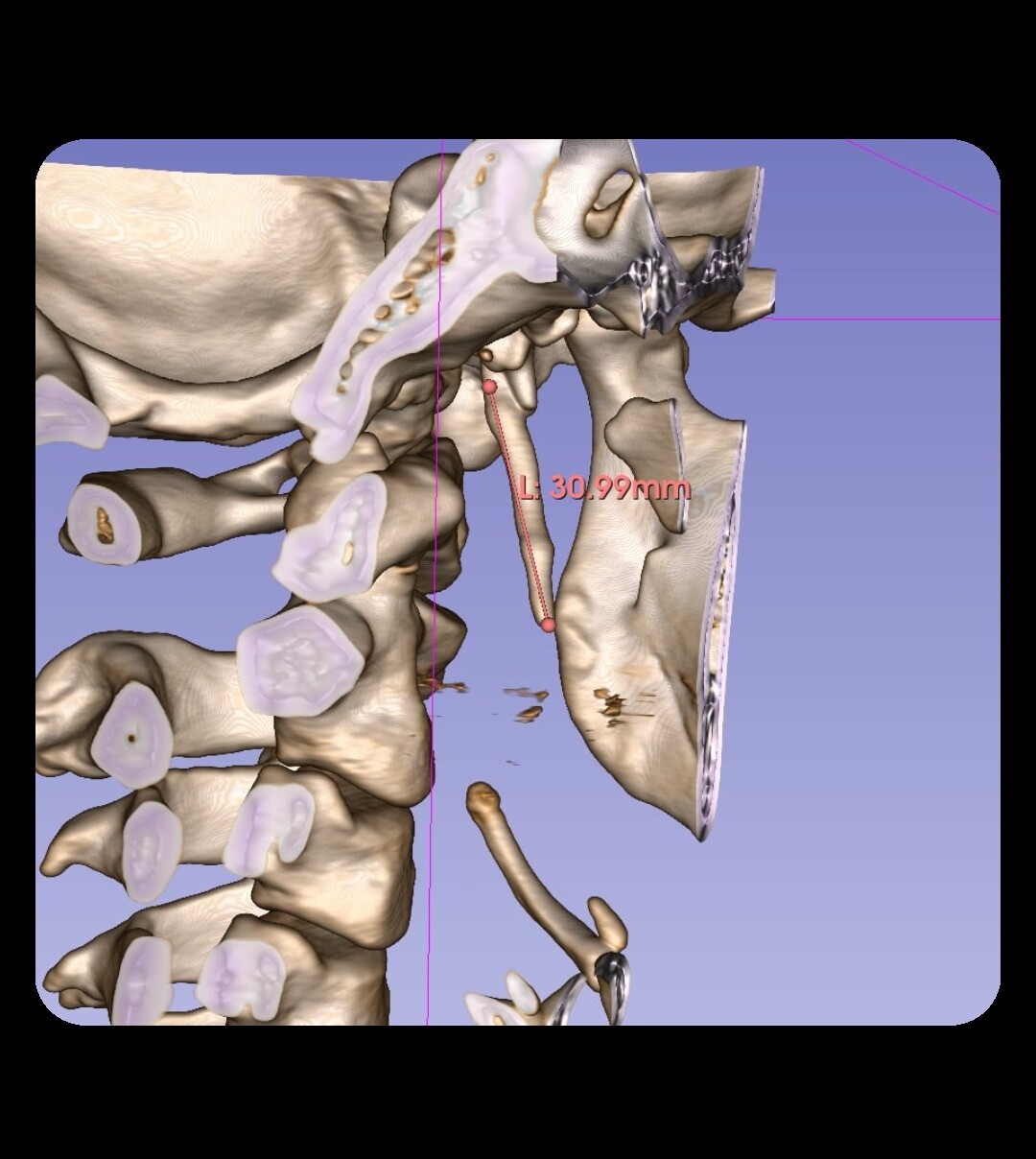
I have CCI and AAI but i dont think i have eagles, my styloides its little longer (3cm and 3,5cm) but there is space between the styloid and C1 unless I turn my head apparently, but my symptoms are there even without turning my head.
And I suspect hyoid bone syndrome
My CCI started in April 2024 and the throat problems started in April 2025 after a strong cough, head tilted forward and tried to make myself vomit because I thought I was going to choke on a cake, I felt a sting towards the thyroid cartilage on the right.
So I would like to know which nerve these soft palate symptoms are due to, can someone help me?
@Calista21269 - The vagus, glossopharyngeal & trigeminal nerves are the main nerves that innervate the soft palate so you’re right in guessing the vagus nerve as it’s part of the group. The pressure you feel going all the way to your stomach is probably also coming from the vagus nerve as you suggested.
It’s very important to remember that the styloids don’t need to be longer than normal to cause ES symptoms. There are other features of the styloids that can cause ES symptoms such as if the styloids are very thick, curved, angled, twisted, pointed or have bony outgrowths coming off of them, for example.
Your comment that the styloid/C1 space is ok unless your turn your head, also suggests that you may have some internal jugular vein compression that is being caused by your styloids pressing the IJV(s) against your C1 vertebra with head turning which can also cause pretty bad symptoms.
The symptoms you listed in your application to this forum are quite common with ES but not so much with hyoid bone syndrome.
Have you checked the symptoms list & what causes them that @Jules wrote?
Thank you for your answer, im lost because some symptoms are similar with HBS ..
I just saw the list I have some symptoms indicated but they are also symptoms caused by hyoid bone syndrome that’s why I’m lost ..
I contacted Dr. Hackman by sending some images of my styloids and my list of symptoms he said this:
“You have elongated styloids, but it is hard to predict which symptoms may be related to these styloids. The throat and tongue pain are more likely to be secondary to the styloids (but cannot promise this), while the hypersalivation may be related to something else”
@Calista21269 I think I mentioned it when I provided you with annotated imaging previously that I couldn’t comment on the hyoid due to the lack of contrast. I think it would be beneficial to get a head and neck CT with contrast as it’ll show us where exactly your greater horns are resting and then we can determine whether or not they may be irritating nerves.
For example, if they are rubbing against the ICAs, then they may be irritating the glossopharyngeal nerves, which can lead to the palate and throat symptoms. But contrast is needed to get an idea where anatomically your greater horns are resting
Yes you mentionned this, i have Soon an appointment with Dr. Chhetri in videocall, who specializes in HBS. I will see what he will tell me, and see if he will say that I must do the CTA… because I have already had a lot of scans
And the glossopharyngeal nerve innervates the carotid sinus nerve pretty vital in HR/BP, so always good to consider mechanical irritation of lower glossopharyngeal nerve by greater horns
I’m glad you have an upcoming appointment w/ Dr. Chhetri, @Calista21269. I hope he’ll help determine if you have HBS. I’m sorry you’ve already had a lot of scans & may still need more, but hopefully he’ll be able to diagnose you with the scans you already have.
Your styloids are very long so I believe getting those shortened as close to your skull base as possible will help reduce a number of your symptoms.
Please let us know what you learn from Dr. Chhetri after your consult with him.
I hope that you’re able to get some clarity by the doctors, but it is difficult for them to say for sure which symptoms are being caused by the styloids or the hyoid bone…we can see that your styloids are elongated, 2.5 cms is generally regarded as the ‘average’, & yours go past the C1 process, but equally your hyoid processes look quite long too. (And you also have quite calcified thyroid cartilage too, which we don’t see that often, that’s worth mentioning to Dr Chetri at your consultation).
We do see hypersalivation as an ES symptoms quite often too, or the opposite, a dry mouth.
Are you saying I have calcified thyroid cartilage? Because normally you’re not supposed to see it like that on the scan? I’m 27 years old and I’m a woman, 52kg (I’ve lost weight) and 1m62 tall