Good idea! Will do. Thanks!!
2 Likes
Looked more into the hyoid bone piece that you pointed out @Isaiah_40_31 . It appears that the left greater horn is pressing into or resting on my carotid sinus on that side. Which is a bit alarming because of it’s role in blood pressure regulation and where vagus, and other nerves pass by. I’ve been to the ER a few times during this journey and all times my throat bone was at it’s sorest. My blood pressure was 155/106 upon admission and I wasn’t panicked or had any cognitive-driven anxiety, but definitely felt off. I wonder if the styloids/scm are culprits for pressure headaches, eye pain, tinnitis and dizziness, while the left greater horn is causing also dizziness/vertigo and vagus nerve and baroreceptor stuff (i.e., acid reflux, blood pressure and HR fluctuations, etc.)?
1 Like
Sent my imaging files to Dr. Cognetti’s team. Desk admin says I should expect a call about setting up a consult hopefully next week! Fingers crossed.
2 Likes
I’m glad you concur with what I pointed out, but I’m sorry your symptoms demonstrate some carotid involvement, @TML. There is a good chance your styloids and the greater horn of your hyoid could both be implicated in your headaches, eye pain, tinnitus, dizziness/vertigo & vagus nerve symptoms.
2 Likes
Thank you for your message! My images look very similar to yours—though the styloid processes are shorter, and the narrowing is more pronounced. I suspect that, as a result of the trauma and the surgery to remove a herniated disc at C6-C7 and the implantation, my atlas (C1) has shifted and the height between C1 and the styloid processes has changed.
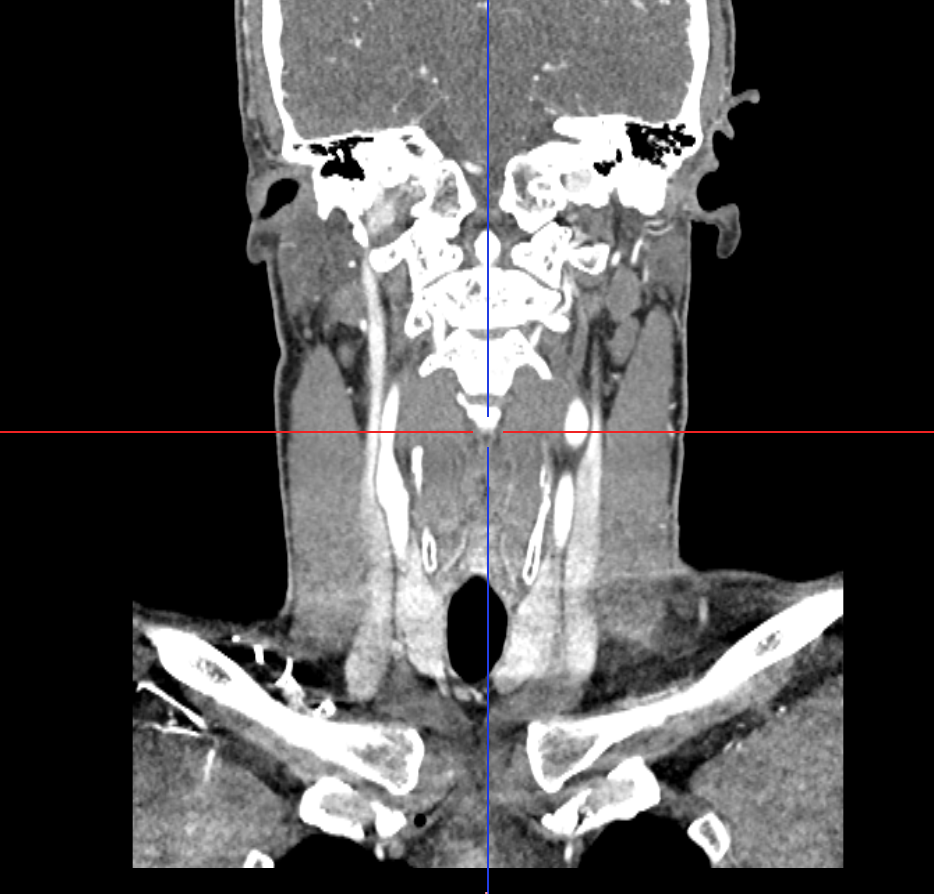

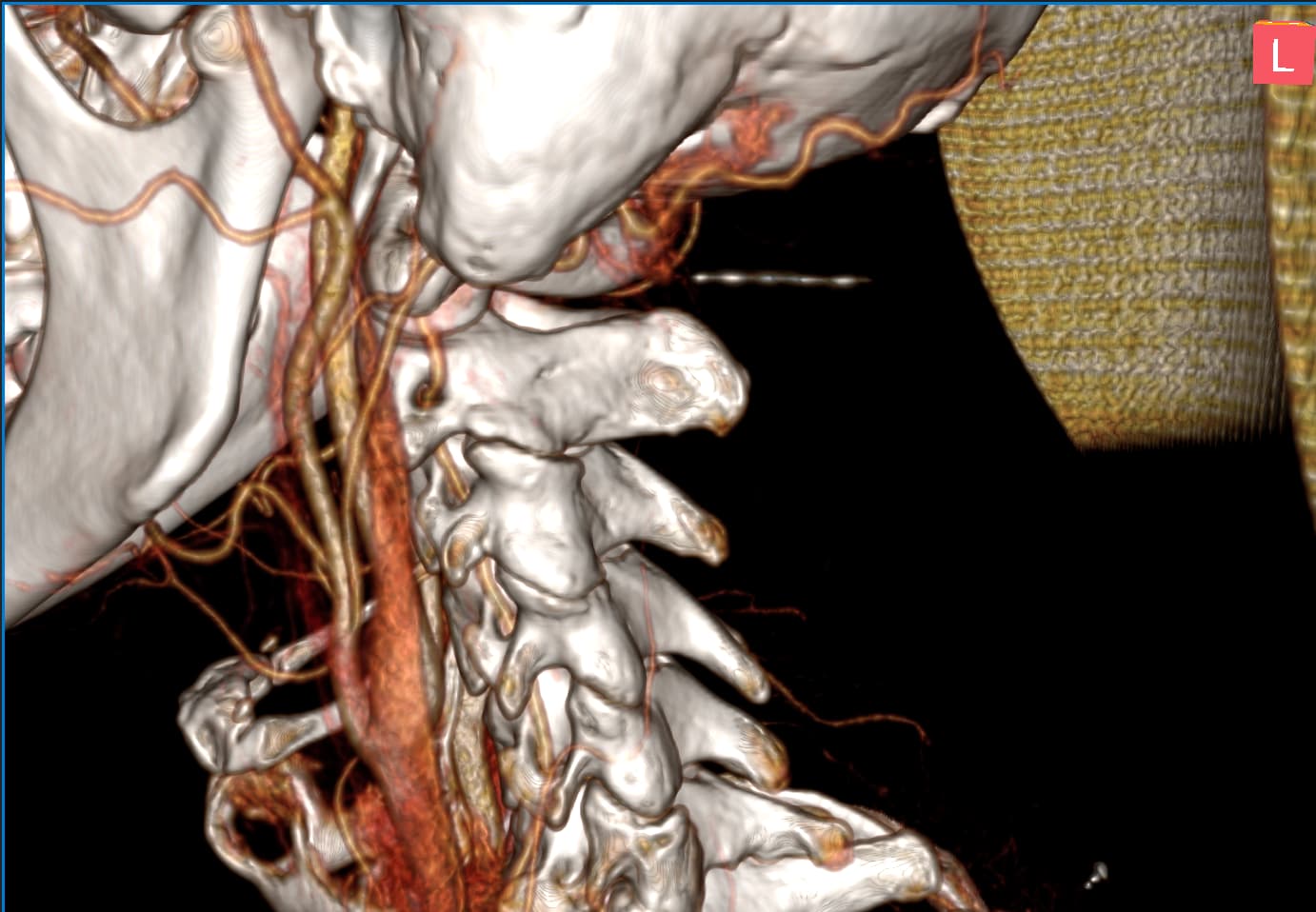
Venus phase on 3D is not very good.
The distance between the styloid processes and the lateral masses of the C1 vertebra is 1.4 mm on the right and 2.2 mm on the left. The styloid processes are symmetrical and measure 25.5 mm in length.
Thanks.
2 Likes
@Ruslan That is a very small gap between the styloid & C1…
@TML a double whammy for you if the hyoid is involved- it will be interesting to hear Dr Cognetti’s take, I don’t know whether he would do anything about the hyoid, so it might mean seeing somebody else for that …
2 Likes
We have one member who had hyoid bone reduction done by Dr. Cognetti some years back so it’s actually possible he can/will help with the hyoid problem, too.
2 Likes
Thanks @Isaiah_40_31 , your memory is better than mine 
2 Likes
We are a team & you often remember things I forget, @Jules. That’s why we work so well together! 
2 Likes
Oh wonderful! Looking forward to hearing his thoughts
1 Like
Hi all,
I just wanted to share with you all my full story, as I don’t think I quite fully captured what has been going on and now, with my greater knowledge in comprehending diagnostic imaging, what my theories are as to why I’m experiencing my debilitating symptoms. Some of my theories might be a stretch, but I’m not really sure what to think anymore. Maybe my ideas align with what some of you may be thinking is contributing to your symptoms.
From 2016-2020 I was an undergraduate student athlete. A competitive distance runner at the national level. In 2020 I had started my Masters in clinical psychology (now in my PhD) and things got too busy to continue running at the frequency and caliber I once did. I became more sedentary, spending long hours in the lab doing research. I always worked on my laptop that sat on a desk that was lower than probably I should have been using. And oddly looking back now, I instead of looking down at my laptop with forward head posture (the posture that likely contributes to straightening of the cervical spine – i.e., military neck), I slouched and rounded my back and tilted my head up to meet the screen at eye level. This makes sense based on my cervical xray imaging, my neck curve appears normal. I’ll get back to my sitting posture later.
3 weeks before I started experiencing my symptoms I did a big 2 hour mountain hike in Ireland. 3 days before my symptoms I did a big 6 hour hike in at home in Canada. I essentially went from doing nothing for 4-5 years (besides being a sedentary graduate student) to doing these massive hikes back to back. I was wearing heavy backpacks during the hikes, which I think is important, which I will circle back to.
3 days after my second hike I was on my drive home from practicum and I remember being quite tired and yawning. When I got home and out of the car I became extremely dizzy which seemed out of nowhere. I ate food and took a nap thinking it would clear up but it didn’t. About a week had gone by and I was essentially bedridden just hoping the dizziness would magically go away.
About 2 weeks into the dizziness there was a night I was sleeping on my stomach. And I remember picking my cheek off the mattress and turn my head so I could sleep on my stomach facing the other way. During the transition I had a felt, and heard, a very bad pop/crack occur near the base of my skull. Maybe c0-c1 or c1-c2. I then, along with the dizziness, experienced random attacks of vertigo, involuntary eye movements, tinnitus which eventually evolved into pulsating/whooshing tinnitus, sound sensitivity, acid reflux, and a full 2 months of a chronic never ending headache that pain medications couldn’t treat (I was taking 6 extra strength Advil and 6 extra strength Tylenol daily). Thankfully the involuntary eye movements are essentially gone and the sound sensitivity seems to be better most days.
I first went to a doctor who diagnosed me with brief episodic vertigo (she really went with the vertigo piece and seemed to not really acknowledge any of my other symptoms). She sent me to physio to get the crystals moved around in my inner ears. That didn’t work. I then went to two other general physicians and both said I had anxiety. As a PhD clinical psychology student, who is well versed in anxiety symptomology, I was quite pissed off. None of this was cognitively driven and there was no way anxiety was causing involuntary eye movements, a chronic headache, and random bouts of vertigo.
Since those visits I’ve been to the ER on 8 separate occasions due to vertigo, difficulty breathing, and pre-syncope episodes. I have had two head/neck CTAs, one head/neck CT w/ contrast, a neck MRI, multiple neck xrays (including flexion and extensions xrays to test for cervical instability), multiple jaw xrays, an abdominal CT, and a chest xray. In not a single one of these did a radiologist report anything of relevance except for bilateral partial arcuate foramen (which can cause vertigo in really rare cases and is considered a natural human variation in the literature – also wouldn’t explain half of my symptoms). I went to 3 different eye doctors for eye exams because my left eye especially has been having difficulties focusing some days and I experience visual snow sometimes. I went to multiple massage therapists, chiros, physiotherapists, and a therapist as all you may know, this can be mentally debilitating. I’m at a point now where true anxiety is setting in as I might have to give up my graduate scholarships and I am supposed to get married at the end of July and I really am concerned about simply standing up.
As time went on I eventually learned what made my dizziness worse – head movements (especially looking down) and swallowing. I eventually learned my headache triggers – laying down or tucking my chin. I also realized that my hyoid bone was really sore on the left side, which didn’t capture my attention for months because I had/have so many other symptoms I’ve been focusing on. I knew something wasn’t right and I eventually got access to my first CTA imaging I got done way back in October, just a few weeks after symptom onset. I obviously didn’t know what I was looking for at first. But with a lot of research on my symptoms ES popped up a lot. And I knew that since my headaches occurred mostly while laying down, my jugulars must be involved and I knew the styloids and C1 are in close proximity. I also knew that my hyoid was killing me and to look in that area as well.
Then I found this lovely forum, where members seem to have a higher IQ (I actually test IQ frequently as a psychology student lol) than most of the doctors I’ve interacted with. You all have helped me narrow down my concerns and what things to hone in on – that being my styloids, hyoid, carotids, and jugulars. Based on our collective thoughts and what makes sense for what I’m experiencing, it appears that both IJVs are, to some degree, being compressed between my styloids and C1. It also appears that the left greater horn of my hyoid bone is pressed up against the area of my carotid sinus. I think a combination of these are contributing to my symptoms. We know IJV compression can cause some nasty symptoms, and I know based on research that pressure or irritation to the area of the carotid sinus can cause dizziness, weakness, and other pre-syncope symptoms that I experience with head movements and swallowing.
Now to my theories as to why this is happening to me, which takes us back to my sitting posture and the hikes.
I think I developed my sitting posture (i.e., rounding back and pulling head up to meet laptop at eye level) subconsciously due to ES. And here’s why: whenever I perform a chin tuck or look down I get a pressure headache and I get dizzy. I think I subconsciously learned to slouch down and curve my head back to increase the styloid-C1 space for my jugulars. I think my cervical curve is normal in that it is the correct direction of curve, but I’m wondering if the way I’ve been sitting has actually made it too pronounced – i.e., too rounded. Which leads me to the second piece – the hikes.
During my lengthy hikes I was carrying heavy backpacks. Seems irrelevant but I think that may have contributed to the hyoid bone piece. My neck curve may be exaggerated to a point from my sitting posture that my hyoid bone rests further back (i.e., my spine is drifting forward towards my hyoid around the level of c3-c4 ish). Or perhaps my greater horns are simply elongated. I think those long hikes with those heavy backpacks made the front of my throat taught (i.e., the skin and muscles) which pushed my hyoid back just the hair that was needed for significant enough compression on my carotids (which could have been building slowly for years). Looking back, my sleep was getting worse for about a year before my symptoms started and I was developing more and more brain frog and memory difficulties. I think the vascular ES piece (space between stlyoids and C1) was already in motion flying under the radar, and it wasn’t until my hyoid bone and carotid sinus problem and upper cervical neck cracking incident that brought the ES symptoms into light and more problematic.
I’m in a position now where if I keep my neck normal (i.e., curved) my hyoid presses into my carotid sinus and I’m dizzy, but if I try to straighten my spine with a chin tuck or just more upright posture, the hyoid seems to drift down a little further (I think it’s being held up slightly by the carotid) and makes my dizziness worse when it comes back into contact with the carotid sinus when my neck goes beck to natural curve (which is probably more dangerous). And not to mention that chin tucks give me bad pressure headaches likely due to the shortening of the styloid-C1 space. I think I’m sort of stuck in this position and forced to just live with my pre-syncope symptoms until I get the hyoid and/or styloids trimmed.
Anyways, that’s my lengthy story. I hope that it resonates with some of you, or helps you think about how your body could be explaining your symptoms.
2 Likes
Any updates @Kit_Cat ??
@Isaiah_40_31 any chance you know how long a greater horn should be?
I found a research paper that said this: The average length of right greater cornu in male and females were 32.78+2.44 mm and 28.89+2.47 mm respectively…
It’s my opinion, that there’s a fair amount of variation in the length of the greater horns of the hyoid bone just as there are with the styloids thus length alone isn’t always the determining factor when there are associated symptoms. Shape, pointiness, angle of growth, how curved, twisted, aligned (i.e. is hyoid parallel to the ground or tipped to L or R, forward or backward?) can all play a role in whether or not the greater horns cause symptoms. As you noted, position ie more anterior or posterior in the neck can also make a difference as to what is getting poked by the greater horns.
The paper was comparing hyoid bone dimensions of adult males w/ adult females.
admin,+EJMS_v2i1_original+last.pdf (491.2 KB)
2 Likes
Hi @TML , thanks for checking in!
I think the appointment with Dr. Hepworth went quite well. He pretty much confirmed what I had talked about with his NP and went over several of my scans with me. His notes just say that the “left jugular vein is absent, right jugular vein is diminutive” and something else that is contributing to intracranial hypertension is “right transverse sigmoid sinus with an arachnoid granulation.” He feels getting a right styloidectomy with jugular vein decompression should be a priority and also said there is a chance of doing the left side in the future.
He was also reviewing my full spinal MRI and showed me what looks like “tethered cord” in my lumbar spine. He thinks that might be contributing to some of the issues, so he wants me to see another specialist for that, but he felt 90% sure about it. I have only barely heard about tethered cord so I wasn’t very thrilled about that and have been feeling a little bit down about another potential diagnosis, but overall the visit was informative.
I am still working on meeting with Dr. Nakaji though, but am appreciative to have met with Dr. Hepworth and heard his professional opinion, insight, etc
Thanks for checking in though! I hope you are feeling okay and have made some progress on your end of things!
3 Likes
@TML - I forgot to acknowledge your symptoms/causes discussion. I love those AHA moments you’ve had about your health that have helped you put the pieces together to better understand what is going on in your body & why. I’ve had a number of those along the way in my ES journey as well.
I’m glad all you’ve learned here & via your other ES/HBS research has helped you better understand your body as that will help you when you consult with doctors going forward.
2 Likes
It sounds like you could well have hit the nail on the head with your theories of how you developed ES/ HBS… I’d add in as well as the posture changed you’ve noticed possibly the exercise hiking & the flying could’ve increased your intracranial pressure to the point of it becoming symptomatic, causing the dizziness? Exercise & flying as well as stress & heat were things which made mine worse. I just hope that you’re able to get surgery, to be able to finish your research & get married… what are your next steps?
2 Likes
I’m sorry that you may have another potential issue to deal with; we’ve had a few members with tethered cord, sending you a hug 
1 Like
Thank you - I appreciate it!
1 Like
I’m also sorry to hear that you possibly have TC. I wonder if that is something Dr. Nakaji would/could give an opinion about? Dr. Hepworth has diagnosed a few of our members w/ TC, & a couple of them have had surgery that was helpful to repair it. It’s just another hurdle to leap toward recovery though. 
2 Likes