9months Post-op - help!

I’ve been lying around since my unilateral ES surgery last year, most days still in too much pain to do much at all, and then there’s also the dreaded vagus nerve issues like heart rate variability and feeling like I might pass out at times, along with the what feels like the entire nerve branch of symptoms. Don’t get me wrong, I have had some good days in there but largely I’m not that much better off. I’ve been hypothesising trying to work out what is going on and today I think I finally understand. I’ve been getting some great relief in the last few weeks from at home fascia release around my scar and on my face and neck to the point where I can actually dig a bit deeper when feeling around my jaw and neck. I noticed today that I have an intensely tight muscle that sits up under the angle of the mandible and travels along to my hyoid and from there up to my chin. I’m guessing it’s either the Digastric muscle or stylohyoideus. I got in there and tried to release it to no avail. In fact I’m in agony now and all symptoms are go - not looking forward to trying to sleep tonight.

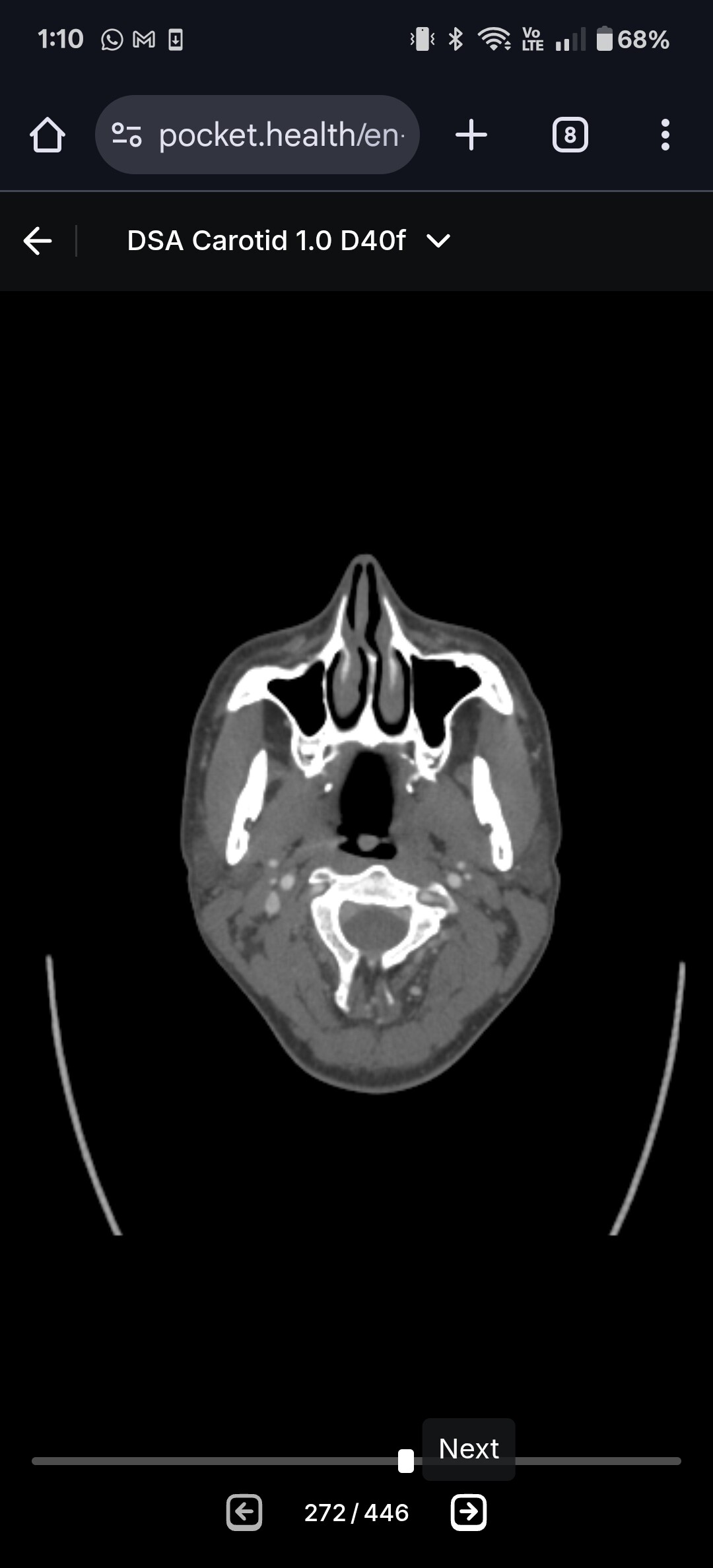
I have an appointment in Sydney with Dr Elliott mid next month for which I have just completed a standard CT venogram with contrast. I’ve studied it and don’t see anything too compressed in there n the painful side (though might need the right done) but I’m guessing when I’m using the muscle things are getting compressed constantly on my left. So I’m wondering, what might be the way forward? I’m guessing you can’t remove the entire digastric muscle without a consequence. It is hyper sensitive and rigid and can’t imagine any form of therapy is going to have much affect on it. I think this has been the issue the entire time though I did need my styloid out too.

Happy to finally feel like I have some solid leads on what needs addressing and keen to hear any thoughts.

2 Likes

@BraveKat can you post the axial view of your hyoid? I just want to double check your greater horns in relation to your carotids.

2 Likes

I’m so sorry that you’re not seeing improvements after your surgery, it’s so rough for you :cry:

Some people have had a resection of the digastric muscle during surgery if it’s causing compressions, it can compress the IJV, which is next to the vagus nerve, so could explain some of your symptoms. Some had the posterior belly removed, I think was the term- here’s a link to a discussion:

Article about jugular vein compression - General - Living with Eagle

Some members have tried dry needling into tense muscles, muscle relaxant meds or botox- I’m really sorry but I can’t remember on your journey what you’ve tried? The SCM muscle & omahyoid can cause issues & compressions too. I’m glad that you’ve narrowed down what might be contributing to your symptoms, it might be worth looking into a physiotherapist & whether there are any exercises which might help a bit? Also I just looked up TENS machines, & they can help with relaxing muscles, and can be used on the neck, so maybe that’s worth a try?

I hope others can help with suggestions as well!

4 Likes

Thank you Jules. I did a bit of digging on here through past threads and did find some have had it removed. It would be great to know if anyone has physically found that their digastric muscle is permanently tense and come to understand why this may be the case (as in which other muscle group or bone position is causing the issue). I have wondered if all of this was caused by my wisdom teeth removal - I haven’t been able to open my mouth properly since. And my symptoms started around this time though I think I’ve always had issues with my swallowing function.

I have a tens machine so will try to find some guidance on using it around the neck - thank you! And perhaps make an appointment with a facial acupuncturist too and see how I get on.

3 Likes

Hi @BraveKat
I can understand your concerns regarding tight muscles in those areas and also have tight areas that are troublesome to relieve near the styloid and neck area. “Post op “

I did some Botox prior to a left styloidectomy, however the muscles that were injected were not the digastric, they did the SCM and some other back neck muscles I can’t remember at the moment,
The result for me was increased instability of the neck amd that increased the pain I felt in my neck with movement and the result was thought to be negative

I had a whiplash event that started all of this for me and a herialted disc in the c5 area

I believe that the body will compensate amd due to neck instability, the other muscles will activate to provide better support of the head when the posterior muscles cannot provide enough support, this in turn will produce fatigue of the secondary support muscles, and then when I got the Botox, I lost there support and induced more neck pain and instability.

The result for me was more bed rest and needed head support until the Botox wore off

I believe now that they should have targeted the digastric muscle, or even to do just one muscle group at a time to better understand the effect of the Botox and potential muscle involvement

As far as the Tens machine,

I love what it can do for me but

I suggest to use caution in any area of the neck

I absolutely can not use it on my neck due to increase in pain

It will cause tense and release type of sensation in the muscles and is pretty hard to just target one muscle or area in the neck

Just my personal novice experience in using it

For my back Arms shoulders legs it is absolutely wonderful and I use it often

There is a wonderful resource that I have found for body anatomy called the “visible body atlas” it is 3d and for me one of the most amazing resources for finding body parts and function

Found in the apple ap store, although it may be available in others places , lmk if you can find it or not

I think there may be other things at play after a surgery that may go unnoticed , proper p/t and identification of tight or limited movement muscles and slow work to relive those tense muscles to regain mobility,

potentially scar tissue in the area that contribute to poor movement

as well as disruption of the fascia may contribute “but I am not really aware of the how the fascia comes into this yet”and still researching the connection

I have done acupuncture and have had great results with one practitioner and have had terrible results from another(inexperienced to say the least) they are not all the same I would do some research of potential practitioners in your area before going in blind to one , but I have found that it was extremely helpful in the neck area as well as the back

Sending prayers that you can find some relief and healing

Research breathing exercises , at some times this is all I can do to relax, and has helped me a great deal

I also have used cbd oil on my neck areas and it seams to work , sometimes better than others but still use it

:heart: :hugs:

3 Likes

Hi, thank you for offering to take a look. You did assess it a few weeks ago and not sure if you were convinced of the hyoid/carotid interaction based on the imaging. Here’s the new images though - if you could take another look that would be great.

@BraveKat the only thing sticking out to me is your left IJV pancaked against C1. Not sure if that’s where the vagus irritation is happening at or not, but seems most logical.

Have you happened to have had a neck xray?

2 Likes

@TML Yes that’s what I can see too and now that I understand the pulling state that the digastric muscle is in, I can also see in the image with the blue arrow that there is some general directional pull running next to the IJV from around the area of the mastoid. It’s easier to see when comparing the right side with the left - a kind of darker grey space beside the vein running between the IJV and the facial bone by the jaw. I think as you suggest, the IJV is being squished against the c1 by the tight digastric. I think the muscle is squishing everything in its path hence why my symptoms are so complex for me to understand - it feels like I have every possible symptom I have read about. I’ve been having a new chest pain in the last couple of weeks (in the middle of my chest) and my heart has started to feel fluttery like I have no beat, and my bottom front teeth are in pain. So I do think there is a chance the carotid is involved but could also just be the vagus nerve. Hoping my specialist appointment is fruitful in understanding more about what might be happening. :slight_smile:

2 Likes

Thank you for your thoughts. Good to know about the tens. I’ve avoided using it near my neck to date as I’m afraid it’s just too worked up and not sure how the nerves might react. I will keep going with (softer) gentle massage over the next few days to see if anything changes - build more of a narrative as to what might be happening - for my consult. I surprisingly slept through the night and only when I woke started to register pain again in the area which was lucky.

Sorry to hear you are continuing to have problems too. Which healthcare professional offered the Botox to you? Would you consider trying it again on the digastric? have you noticed any flattening of structures in post op imaging?

At home fascia release is one of the only things I can do to feel better. I managed to remove some tension out of the nerves in my cheeks leading to my mouth and around my scar (which sits right up under my jaw). It’s a gentle stretching of the skin technique. Placing one or two fingers of each hand close together on the skin and pulling them in opposite directions. You don’t want to me able to feel muscle when pushing on the skin, it’s just a targeted skin/fascia exercise. Helps to warm the skin first with a heat pack or after a hot shower. After a couple of days of doing this all over my face and neck I was a lot less sensitive and could go in with more of a pitching technique where I left the skin/fascia up and give it a general release. It’s very effective.

3 Likes

The other thing is that my lower jaw seems to be rotated toward the right, which could be the reason for pressure on the hyoid and the digastric. Or maybe it’s the vertebrae that’s out in this image

3 Likes

Normal for both jaw and vertebrae to be off center/crooked. Here is my c2 that looks wildly off. Neuroradiologist said it’s within normal limits. None of our spines are straight! My jaw, hyoid, and vertebrae are all off from eachother. Usually you’ll see a vertebrae off center but then the vertebrae below or above brings it back to center or near center (think of it as like a micro-scoliosis). As for the jaw, it’s likely crooked to counterbalance vertebral twists or you chew/talk more one side. I discovered my left masseter is much thicker than my right, and most of my digastric muscle spasms happen on the right - so almost like I’m using my right digastric heavily to open my mouth while I use mainly my left masseter to close my mouth or chew.

3 Likes

Sounds like you’re doing well with some release yourself, good for you! I’ve never tried a Tens myself on my neck, but it is suggested online as being helpful, definitely don’t want you to get worse as it has for @mekanX !

It’s just mind boggling how different muscles work together, and an imbalance in one can affect a whole chain, and quite a puzzle as to whether these have developed because of inflammation or posture or ES etc, or whether these cause it! We had an interesting discussion by a couple of members about having very enlarged SCM muscles, and that being linked to shoulder injuries potentially at birth!

3 Likes

I’m really interested in trying to understand more too. While I managed to sleep that night, I have not relieved the digastric tension unfortunately. I do however have some theories on what might be going on for me generally though.
I have three cysts including one Tarlov cyst at S2 which I think have been there for at least the last twenty or so years. I think these limit my anterior pelvic tilt during everyday activities. While I wouldnt say I have constant nerve related symptoms from them, I have had a handful of episodic symptoms over the years that I now think were caused by these being flared up - one random day of irritable bowel and urinary dysfunction, a number with one sharp random nerve pain into my foot etc. I think this limitation in movement also contributed in part to a severe labral tear that I have also just had diagnosed on my right hip (in combination with a sports injury 16 years ago).

What I have noticed is that I have very limited lower back range of motion in the anterior position. It’s almost like a surf board - completely flat even if I try very hard to engage abs - when bending forward. It just doesn’t budge. Meanwhile by Thoraric and cervical spine take all the bending load. Something similar happens when I flip onto my back and do a similar movement, equivalent to a sit up, say like lifting myself out of the bed. I get minimal upward tilt in my tailbone/lower spine during this movement and what I’ve noticed is I’m engaging my upper neck muscles (those sitting under the jaw including the digastric) to lift my head. This further limits the chance to engage my core to assist with this movement. If im doing this every time I get up from a chair, off the couch etc, ive been slowly weakening all of the muscles required for these movements and putting excessive strain on my upper neck muscles. I’m not sure if the calcified ligament came as a consequence of this or if it was a combination of things but now that it’s gone on the left, my digastric muscle is under even more tension. And the symptoms are so similar to the symptoms I felt pre-op, there’s a chance if it hadn’t grown out to my carotid that it would be difficult to find disparities between the symptoms pre and post op. In saying that, I would say once the ligament is a bone, there’s no going back and it needs to come out.

I think my wisdom teeth removal 13 years ago under general anaesthetic also exacerbated the issue, but if I already had weakness in the neck from misuse, it likely couldn’t be helped. Perhaps if I had just had local anaesthesia though, I would have engaged muslces to resist the forces of the tugging and reduced the intensity of the damage caused by this.

Did you find post op that you had any muscle weakness/tightness in the neck?

3 Likes

Wow that is wild.

Do you have any muscle tension in the area? Could there be a force on it pulling it in that direction?

1 Like

There are many muscles attached to C2, so can’t point to any single force. I think there’s two things going on. #1 my right leg is longer than my left which puts the right side of my pelvis higher. This results in my thoracic/lumbar spine being slanted to the left, then my lower cervical spine compensates for it, then my upper cervical spine compensates for the lower. I think the leg length discrepancy set the stage. And running tens of thousands of miles with this discrepancy as a competitive distance runner. #2 the neck will do remarkable self subconscious adjustments to get you best compensated with elongated styloids. So it’s possible that my upper cervical spine is dictating some of the compensations.

2 Likes

@BraveKat sometimes the digastric can have tension in it when your chest '“runs away” from your neck, in that your sternum is pointed downwards even though you’re looking forward. This can happen due to anterior pelvic tilt, causing the abdominals be taut, pulling down the collarbones, and pulling the muscles attached to the bottom of the hyoid taut, and putting tension on the suprahyoids (including digastric). So it’s possible that your digastric feels tight, but it may be actually taut (stretched to the point it’s stiff). What happens when you consciously pull your chest up and pretend you are pointing your sternum where the wall meets the ceiling? I suspect due to years of your styloid causing ijv compression you subconsciously resorted to dropping the sternum and while looking straight your heads actually in extension to open the styloid-c1 space. I wonder if you practice chin tucking and tilting sternum upwards might help provide less strain on the digastric?

1 Like

@bravekat Thanks for the info on the fascia release

Will need to try it out and see if I can loosen things up

I had the Botox treatment at queen’s hospital under dr Hui , I would do the digastric to see if there is relief, but would really like more of a work up to point to it as a potential issue first,

they had just started to offer the service for compression patients and was among the first to receive the treatment , pre op
I haven’t looked into my scans for a while and not sure if there is evidence of it flattening at this time

I am getting ready to get another evaluation and see if anything has changed and what things look like now,

But as for now not sure , just in limbo atm😃

2 Likes

Really interesting thoughts @TML ; if you have all that going on it sounds like there’ll be alot of work for you to do to retrain muscles after you have surgery before you see any benefits? :cry:

1 Like

I think I should see a huge improvement once my greater horn is trimmed. The collapsing and BP drops are what’s most debilitating, and I suspect it’s causing my dizziness. Once I get it trimmed I should be able to move around more. Got orthotics for the leg length discrepancy so that’ll sort itself out with more time on feet. I think my styloids are mostly causing the headaches are ear symptoms.

Something else that has been bothering me actually for years but has been worse since my symptoms began is my left eye. Doesn’t seem to move smoothly with my other eye and is often reddish. I was looking at my head CTA and I wonder if it has to do with my cavernous sinus on that side, or the veins around it. I wonder if IJV compression is causing it to back up, or if it’s a whole separate thing, or if it’s nothing at all.

1 Like

@BraveKat - Because I’ve had back & hip problems for decades, I learned the “proper way” to get in & out of bed, & in & out of a car, to save my back/hips. When getting out of bed, roll onto your side closest to the edge of the bed & swing your legs off the bed which naturally helps your upper body sit up using your oblique abdominal muscles. Sitting straight up in bed is like doing a sit-up on a soft surface & is hard on the back no matter what its condition.

When getting into a car, go in backwards i.e. turn your back to the opening & put your bottom on the car seat then rotate your legs in instead of putting one leg in then hoisting your body in w/ the weight on that one leg. Getting out of the car is done the same as getting in - rotate your legs out & onto the ground then stand versus putting one leg out, moving your body out & then the last leg.

Let me know once you’ve tried these new approaches to old ways of doing things if they help you at all.

1 Like