Good that the IJV compression is confirmed … looking at the axial view image where you’ve put the arrow, that looks pretty substantial compression! I would disagree (obviously not a doctor!) disagree with ‘the corresponding lateral mass of the axis body’ - maybe that’s lost in translation but this implies it’s the body of the C1 but it’s the transverse process which is compressing the IJV…
I would think looking at your imaging you may well need a C1 shave as well as the styloid being removed to get the best chance of full resolution of symptoms, so that’s something to consider.
It sounds as if there’s no compression on the arteries, but bearing in mind there’s contact, this could potentially cause pain, and also there could be some compression with turning your head maybe?
Thank you so much for answering my messages! I really don’t know what to do. I need to see my surgeon. I was comfortable with the intraoral approach, since I know that the closer the incision is to the base of the skull, the more dangerous the surgery is.
I will see if my surgeon can assure me that he can cut where the compression is using an intraoral approach. Otherwise it will be more complicated. Mainly because I don’t know which other doctor would be willing to operate on me. And the surgery cost. I would also like them to evaluate how significant the compression is, since the study does not indicate that.
HOORAY!!! You FINALLY have a diagnosis that helps explain your symptoms, @Javi47!!
The reasons we believe the external approach to ES surgery is safer & better than the intraoral approach are the veins, arteries, nerves & muscles are visible to the doctor’s eyes during external surgery so they can be treated carefully, & the styloid can be cut off very close to the skull base which is important when there is IJV compression. With the intraoral approach, the doctor is basically cutting into the throat tissue w/ a laser without being able to see any of nerves, blood vessels & muscles. Typically, the styloids can’t be cut as close to the skull base using the intraoral approach. Another downside for you would be that the transverse process of your C1 vertebra most likely needs to have some shaved off of it, as @Jules noted, & that cannot be done via the intraoral approach. Perhaps in your country you would need two surgeries - one for the styloidectomy by the doctor you’re currently seeing, & later on, one by a neurosurgeon who could shave the TP of C1? You will get the best results from your surgery if both could be done at once.
Please let us know what you find out from your doctor regarding how he will do your surgery & if he can do anything to help decompress your IJV.
Sorry to bother you again!
I’m looking at my exam again. I noticed that the report says that kind of the tip of the apophysis is causing the compression.
“The corresponding internal carotid artery contacts the distal third of the aforementioned bony structure.”
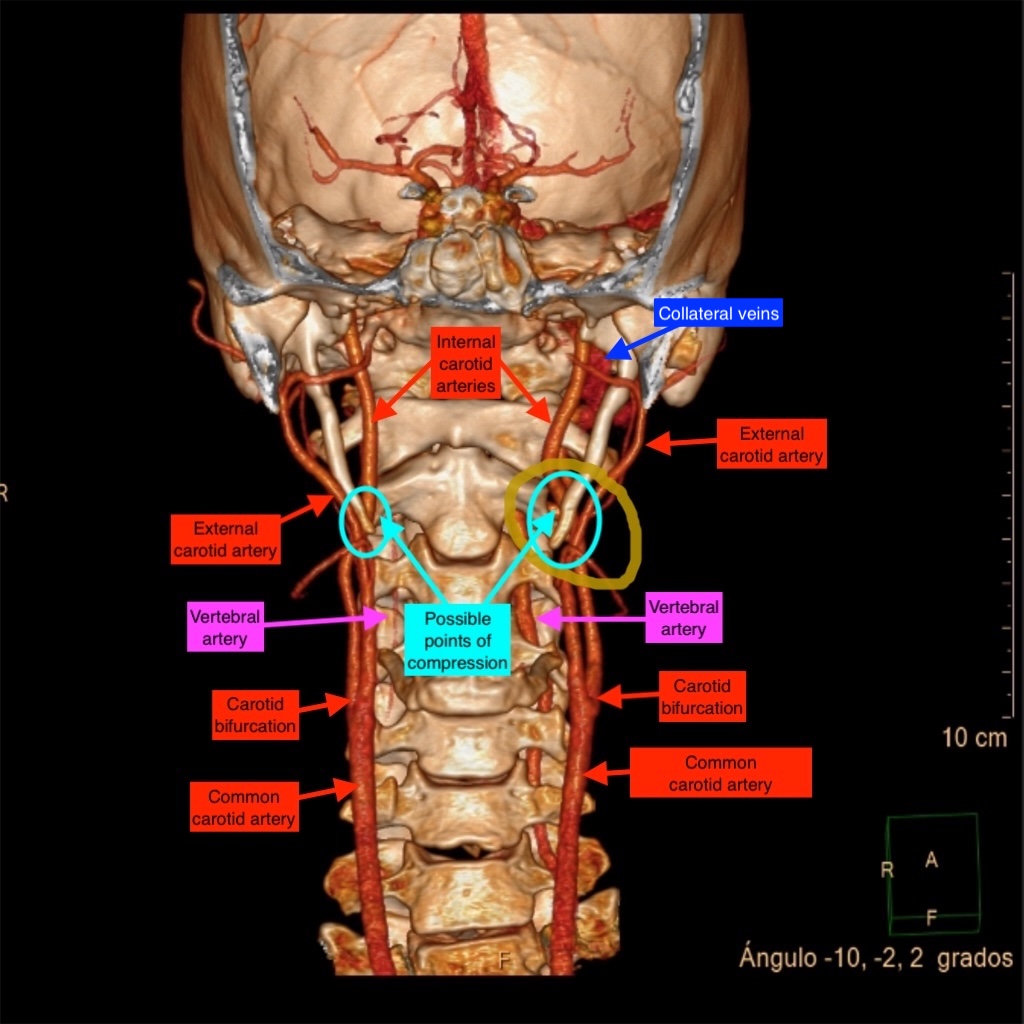
Can you tell me if these are the internal jugular veins? I marked where I think that maybe the compression is (no idea xD)
The vascular tissues in the picture you posted are your internal & external carotid arteries & your vertebral arteries. I’ve annotated the image for you.
Something that’s a bit concerning to me besides the possibility of bilateral ICA compression is that your right vertebral artery is barely visible which could suggest it is suffering from compression up closer to your skull base/C1. Also there are dense collateral veins on the left side which could suggest you have both IJV & ICA compression on that side.
I was searching for information and the carotid seems not to be the same as jugular vein. My exam result says that I have an internal jugular vein compression, but apparently my 3D image doesn’t show it. Right?
You are correct, @Javi47. The IJV is not visible in the picture you posted. I’m guessing you had a CTA not a CTV which would show your IJVs. A CT with contrast of the same area would show both your IJVs & carotids without being as specialized as a CTA or CTV.
Thank you for the picture you posted. It answers some questions I’ve had about the smaller arteries that are in the area around the carotids.
Okay, an update. Today I saw my surgeon and he told me he still preferred the intraoral approach, even after I showed him the compression. He said he didn’t find it significant, and that my symptoms would be worse if it were. He told me he would operate using robotics, removing about 1.5 cm of the styloid process (mine measure 4 cm).
I asked him if he could remove above the compression and he said no, that it would stay as is, but that my symptoms might not be related to that at all. He said an external approach wouldn’t guarantee anything either and was much more dangerous. I’m really frustrated and distressed, since this surgeon came highly recommended and works at a prestigious place here in Argentina.
He seems more interested in operating on me and collecting the thousands of dollars it would cost me than anything else. It’s been really hard to find a surgeon who doesn’t seem like a damn salesman who doesn’t care at all about your wellbeing. I don’t know what to do now. But anyway, thanks for helping me, everyone — I’ll see what I can do. I’m really exhausted and this seems like it’s never going to end. I think anxiety and depression will get me before anything else does, haha.
I’m sorry that he didn’t believe the compression was significant- whether it is or isn’t, either way 1.5cms off a 4cm styloid might well be unlikely to stop symptoms ie nerve related ones like anxiety & pain. So, especially if you’re having to pay for this surgery, I would look at alternatives. Is travelling anywhere an option? Some members have had/ are looking at surgery in Brazil for example?