Introduction

Hello,

My name is Pam, and I was recently diagnosed with Eagle Syndrome through a CT scan imaging which shows that the styloid bones on both sides are elongated. It also shows that I have TMJ, my jaw is back further than it should be. I believe that that’s from tightening everything to try to be able to talk, but am unsure.

My worst symptom is that I have mostly lost my voice. I did not start to have any issues with my voice until the beginning of 2025, but it steadily got worse throughout the year until I had to leave work to try to heal. I did return to work 2 months ago, but it continues to be a major struggle to speak, so I am taking June off to try to find relief and a solution.

Years ago, I was diagnosed vasovagal syncope after passing out, and I’m now wondering if that is also due to the elongated styloid bones. I was diagnosed with syncope through a tilt table test, during which I immediately blacked out and woke up to the nurse leaning over me letting me know that she was massaging my heart. Needless to say, that was not a pleasant experience.

Overall I’m experiencing:

Vocal Dysphonia, Tinnitus (continuous), head, neck and sinus pressure when speaking, vasovagal syncope, heart arrhythmia, anxiety (did not have before this past year, and am experiencing little to no relief with anxiety medications), insomnia, intolerance to extreme hot or cold and temperature changes (I get lightheaded and dizzy), tightness in chest that feels like congestion, and an intense sharp pain in my left chest (I’ve had this the longest and I can only describe it as feeling like there is a hook pulling downward on my heart (when this happens I am unable to take more than a very shallow breath without intense pain) and within a few minutes it disappears. I’ve had different cardiovascular testing done and other than the arrhythmia no doctor can find anything wrong, and they do not seem concerned.

Most recently with the voice issues, whenever I try to speak, it creates an immense pressure in my forehead and my sinuses. My sinuses feel like they are clogged, but once I stop talking, it begins to somewhat clear out and I can breathe. My forehead also does not hurt unless I am speaking. I have been put on an allergy and acid reflux protocol for over a year with zero change or relief.

When I left work the first time, I was at a point where I was whispering because I could barely get sounds out. Through consistent acupuncture and resting my voice I can somewhat speak, but it sounds like I have a very bad cold and it’s very painful in my forehead and sinuses. Also, I can also only sustain speaking for a short period of time, before it gets difficult to understand and I go to a whisper for pain relief.

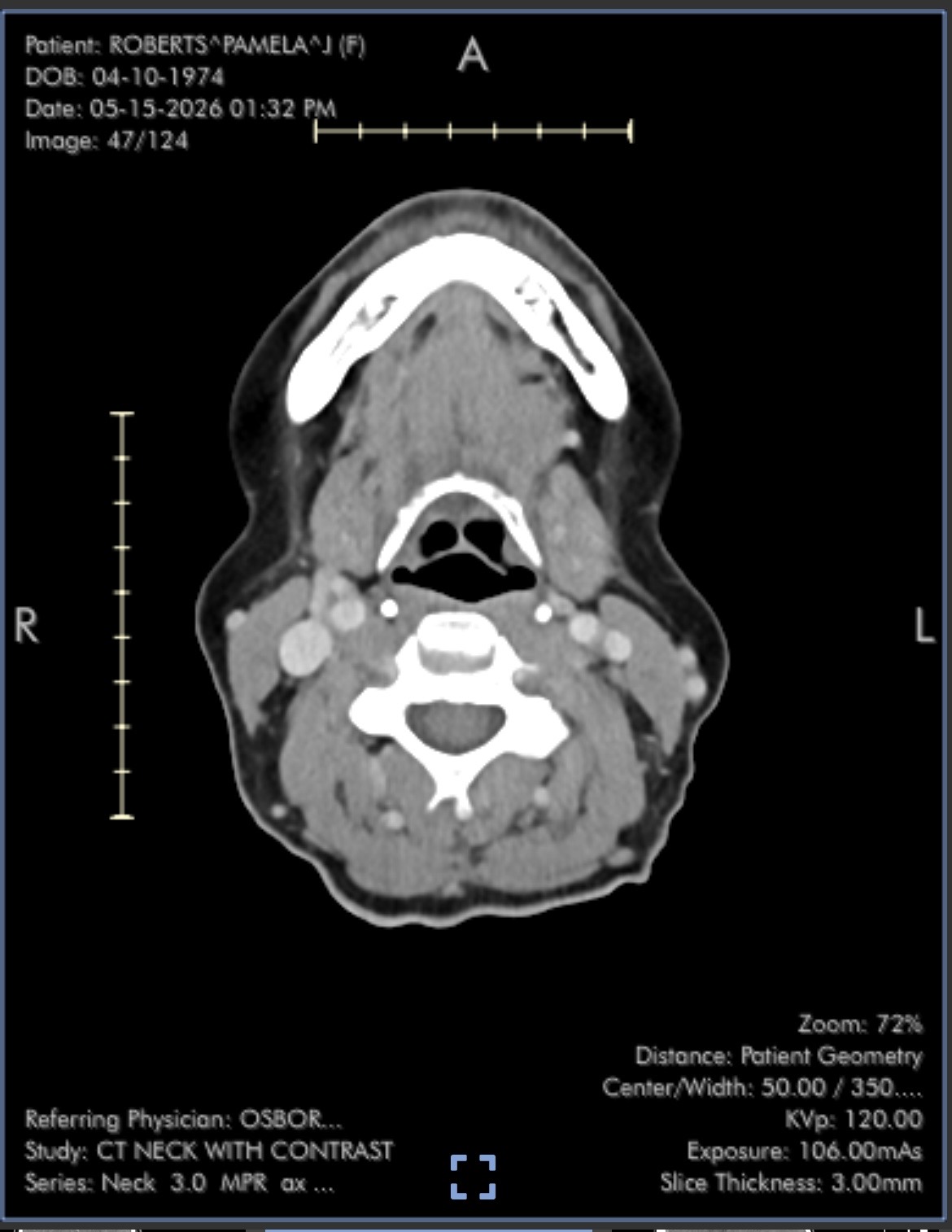
I’ll attach my CT images below.

Thank you for listening, and I look forward to everyone’s knowledge,
Pam

1 Like

Wow those look like an issue to me. Those are long, I cannot see how they are not causing issues. Definitely worth ruling out!

2 Likes

@Pamela1 - I’m very sorry for how severe your symptoms have become. Your styloids are quite long, irregularly shaped, & very pointed at the tips. It looks like you had your CT w/o contrast so I can’t comment on possible vascular contact your styloids might be making with either your internal jugular veins or internal/external carotid arteries.

It sounds like you have significant vagus nerve irritation or compression being caused by your styloids as most of your symptoms can be attributed to the vagus nerve being unhappy. Your vasovagal syncope, though possibly vagus nerve related also sounds to me like it could be caused by compression of your carotid artery(ies) by your styloid(s) as that can cause the blacking out during the tilt table test, & your heart pain, though the heart pain can also be caused by your vagus nerve. I know because I had that, too, prior to my styloidectomies.

The symptoms you mentioned that we know can be related to vagus nerve irritation are vocal dysphonia, possibly the head/neck/sinus pressure when speaking (though the trigeminal nerve could be contributing there), insomnia, temperature intolerance, & chest tightness/heart pain. Increased anxiety can also be related to vagus irritation. Here’s an illustration of where the vagus nerve is located in the body which may help you see why it can cause so many symptoms:

Elongated styloids can cause a shift in the position of the jaw as the body compensates to accommodate the pressure the styloids are putting on smaller muscles & significant cranial nerves. We’ve had members mention that their TMJ issues stopped & jaw position changed once their styloids were cut back.

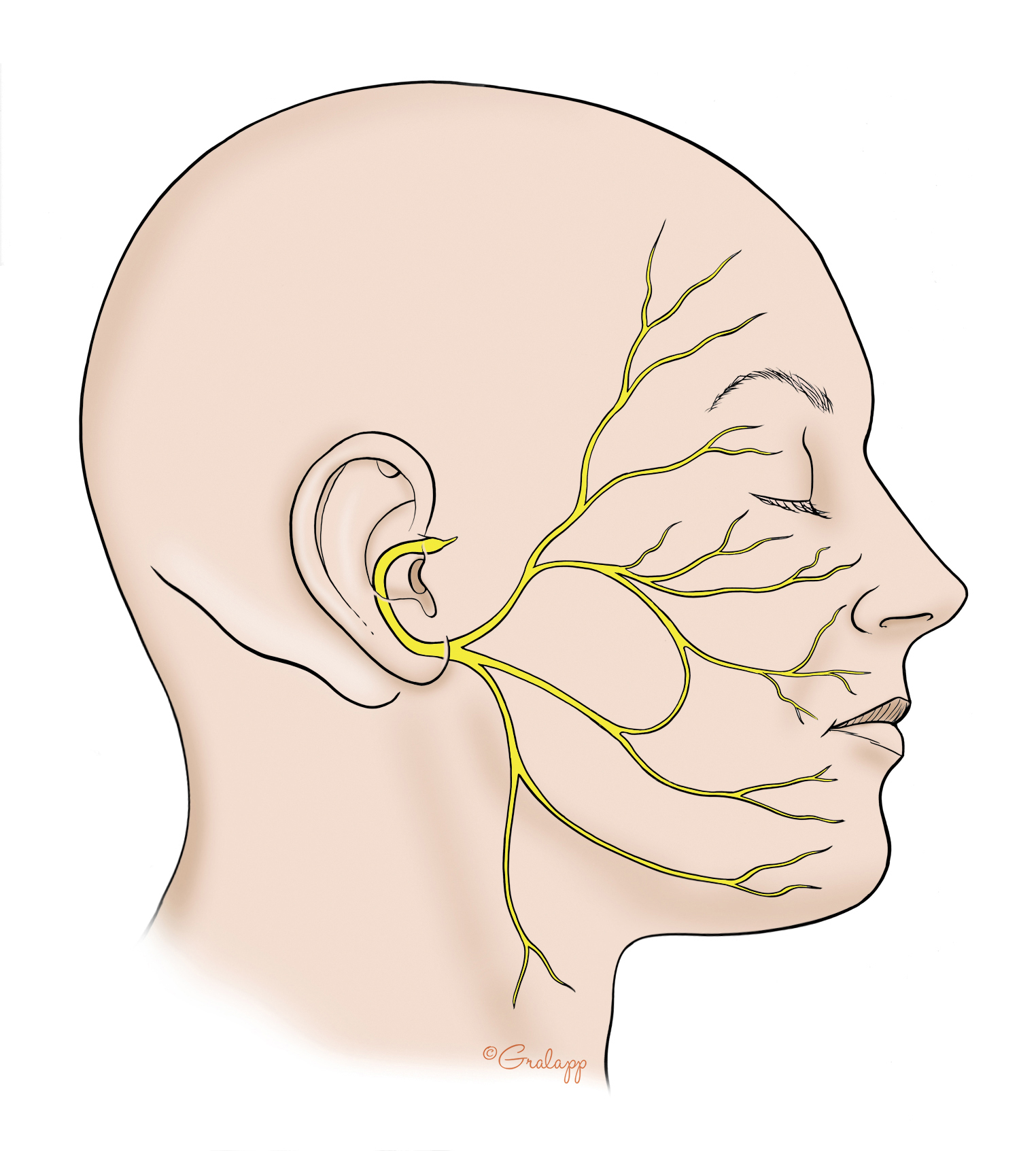
The trigeminal & facial nerves are other cranial nerves that are often irritated by elongated styloids. These can cause the feeling of pressure/pain in teeth, sinuses & face. Here are illustrations of the locations of those nerves:

Have you had a consult with any of the doctors on our Doctors List for your state? There are several & getting at least a couple of opinions is a good idea. You want to choose a doctor who will use the transcervical (through the neck) approach to cut your styloids as close to the skull base as possible. If you want them both removed in one surgery then Dr. Hackman in NC is the doctor to contact as he is one of the few on our Doctors List who routinely does that. Here’s the link to our Doctors List:

Here are also links to a post written by @Jules regarding ES symptoms & possible causes & one about ES surgery:

Finally here’s a post from one of our members who had terrible vagus nerve symptoms & for whom surgery provided excellent recovery:

Getting your styloid cut back close to your skull base should help immensely with getting your symptoms to resolve.

3 Likes

If you can, please post 3d ct images of your hyoid bone at different angles.

Can i ask how long can you speak for before feeling symptoms?

Does it vary with volume… i.e if you spoke louder, you get symptoms a lot quicker etc?

3 Likes

I’m sorry that you’ve had to take time off work with voice issues… It has been mentioned quite a bit on the forum people having trouble talking or singing with ES, so you’re not alone…
I agree with @Isaiah_40_31 about the symptoms you’re having, and hope that you can get a referral to one of the doctors experienced with this :hugs:

2 Likes

These are the only images that I have from that CT scan, but I also had a cerebral angiogram and a CT with contrast. Both of those show that there is no problem with the jugular vein or the carotid artery. When I get back home later today, I will see if I’m able to pull up images with the hyoid bone.

I can usually speak a sentence or two somewhat in my normal voice, but it very quickly dissipates. It starts to get very raspy and horse to the point that I am straining my neck muscles to try to speak. And then eventually, it just goes to whisper. If I am laughing, it opens up, and I can speak. It’s when I’m trying to talk in my normal vocal range. I can sing at a higher register, but the SPL that I saw a few days ago did let me know that if I tried to speak at the higher register over a long period of time, that the vocal folds would also start to tighten at that register.

I saw a speech language pathologist this past Friday and she diagnosed me with Abductor Spasmodic Dysphonia. My vocal folds are sticking together at the bottom when I try to speak. She is the third speech language pathologist that I’ve been to this past year. With the other two, I went through the full protocol and they were simply just frustrated with me and made me feel like I was doing it on purpose. This SPL let me know that it is a neurological condition and that I have no control over it, which even more so makes me think that I can heal if I have the styloids removed. She said that this is a lifelong condition, but they can help with it by injecting Botox into one of your vocal folds. However, I told her that I would still like to have the Eagle syndrome surgery to remove the styloids, because that could be the root cause of it. She is very open to whatever I need to do to heal.

3 Likes

Thank you so much for all of this information! So far I have consulted with Dr. Prendes at the Cleveland clinic and Dr. Osborne in Los Angeles. I have a zoom appointment with Dr. Constantino next week.

I decided not to go with Dr. Osborne because he doesn’t take insurance, and due to the fact that I tore my ACL and meniscus very early on in this year while skiing, I’ve already met my deductible. I don’t want to have to pay out-of-pocket when there are other doctors that take my insurance.

Dr. Prendes is wonderful, and said that he will do the surgery when I’m ready, but has warned me that it may cause other issues after surgery like the pain when chewing, etc.

I’m consulting with Dr. Constantino, after reading others experiences with him from this forum, just to get another opinion and make sure that I’m making the best choice for my health.

2 Likes

Welcome @Pamela1 I am so sorry your symptoms have been affecting your life so much!!

3 Likes

@Pamela1 - We don’t have Dr. Prendes on our Doctors List, but if he does your surgery & you have a good outcome, we’ll add him as we’re always looking for new doctors who are experienced with ES surgery.

If you took the time to read the surgery info I sent yesterday (I realize I sent you a ton of reading w/ all the links I sent), you would have seen the list of questions we recommend asking any doctor you consult with about ES surgery. I’m putting it below just in case you didn’t see it. The most critical questions are which surgical approach does the doctor do & how much styloid is removed (as close to skull base as possible is the best answer).

Dr. Costantino typically only does surgeries where internal jugular vein (IJV) compression is present. Do you suspect you might have IJV compression? If not, you might want to cancel your appointment & make one with one of the doctors on our list who deals more exclusively with the non-vascular version of ES like Dr. Hackman, whom I mentioned yesterday. I just want to save you time & $ in case you don’t need the help of someone as specialized as Dr. Costantino.

**Questions To Ask Your Doctor:

  1. How many ES surgeries have they done and what was the success rate?
  2. Whether they’re going to operate externally, or intraoral- through the mouth. Whilst some members have had successful surgeries with intraoral, external is better for seeing all the structures, to be able to remove more of the styloids, & also there’s less chance of infection.
  3. You need to ask how much of the styloid he’ll remove- as much as possible is best- & anything left needs to be smoothed off. The piece needs to be removed too- some doctors have snapped it off & left it in! If the styloid is only shortened a bit it can still cause symptoms.
  4. If your stylohyoid ligaments are calcified, then any calcified section needs to be removed too.
  5. There’s usually swelling after surgery; you could ask if a drain’s put in to reduce swelling, or if steroids are prescribed. It’s not essential, but can help with recovery a bit.
  6. Will it be a day case surgery or will you need to stay in?
  7. Obviously ask the risks- we know from experience on here that temporary damage to the facial nerve is quite common, and also the hypoglossal nerve and the accessory nerve. These usually recovery very quickly but in some cases members have needed physiotherapy. There is also the risk of catching a blood vessel or having a stroke, but these are very rare.
  8. Ask if the surgeon monitors the nerves- this should be done to see if there’s stress on the nerves to avoid damage as mentioned above.
  9. What painkillers will be prescribed afterwards.
  10. Ask about recovery- most doctors either down play it or are genuinely unaware of how long the recovery can take!
  11. We have heard that occasionally doctors use surgical clips which are left in, it’s been suggested that these could interfere with chiropractic adjustments if needed post-surgery, so something to consider, and also we have now seen members who’ve been left in pain from the clips and needed further surgery to remove them, so do ask if they might be used.
3 Likes

Thank you. Thankfully I think I’m moving along the right path to healing. It may be a long, rocky path but I’m hopeful that I’ll get there!

3 Likes

Thank you for this, and no I hadn’t viewed it yet.

3 Likes

I did look into Dr. Hackman last night after seeing him mentioned in another post. I plan on calling tomorrow. Thank you for the information on Dr. Constantino. I may cancel the appointment since it doesn’t seem to be related to vein issues according to the cerebral angiogram that I had done.

3 Likes

If you are having any of the symptoms of vascular compression listed in the ES Symptoms & Possible Causes post, by all means keep your appt w/ Dr. C, but in the absence of those, seeing Dr. Hackman (terrible last name for a surgeon :rofl:) would be an excellent option.

3 Likes

:joy: I agree about the name. I don’t know if he takes my insurance, but I’ll find out tomorrow when I call.
I also want to have another meeting with Dr. Prendes at Cleveland Clinic and discuss all of the questions that you shared.

2 Likes

Is this showing the hyoid?

I am sorry, I cannot tell from those kinds of images.

I would only be able to tell from 3d images.

If you have the raw CT images, you need to open them up in dicom software, and then you can generate your own 3d model that you can move around in all directions and angles.

An example is on the images on my post above?

@Isaiah_40_31 is there a miniguide on how to do this? Which software do you recommend? I am currently using a Chinese model called Xiaosai viewer which i think works very well, but the download page is in Chinese

1 Like

@Pamela1 I can’t see the images at all…

It’s pretty common after surgery to have pain or difficulty chewing and opening your mouth wide, it usually resolves after a week or two, we do suggest the members get soft foods or smoothie ingredients ready in case.
I’m glad that the speech therapist you saw was helpful and I agree that it’s worth trying the ES surgery first to see if this is the cause or irritated nerves…
@virenlondon there’s a couple of tutorials about uploading images if that’s relevant:
RadiANT DICOM Viewer tutorial - General - Living with Eagle
3D Slicer Tutorial Video - Welcome - Living with Eagle

2 Likes

I actually just spoke with Cleveland Clinic this morning, and he wants to hold off on the surgery now that I have a diagnosis of Abductor Spasmodic Dysphonia. He wants to try the Botox in my vocal fold first to see if this helps my voice and be able to avoid the surgery. I am on board with trying the Botox for relief, but Abductor Spasmodic Dysphonia is a life-long neurological condition and you have to have the Botox reinserted every 3-4 months. What if Eagle Syndrome is the root cause? I’m now looking into getting a referral for Dr. Hackman to discuss surgery.

3 Likes

@Pamela1

Dr. Prendes could be referring to First Bite Syndrome which occurs when you chew the first few bites of food as you start eating or it could be as @Jules mentioned that your jaw joints are sore from the surgical procedure. Most people also have a very sore throat for a few days from the breathing tube used during surgery. All of these problems usually resolve w/in a few days to a couple of months post op. Many of us have experienced them.

Your hyoid bone is visible in the image you posted. I’ve annotated it & included it below. It looks very nice & even to me, but I can’t tell you anything other than that i.e. whether it could be causing any of your symptoms.

This could be a consequence of a very irritated vagus nerve & months of vocal dysfunction. Trying Botox for symptoms relief is a fine idea, but as you noted, it will only be a “band-aid” as it won’t treat the cause of the problem, only the symptoms, & you’d need to be re-injected on a somewhat regular basis for continued relief.

I’m really glad you’re planning to consult w/ Dr. Hackman. I think he will be tremendously helpful for you.

1 Like

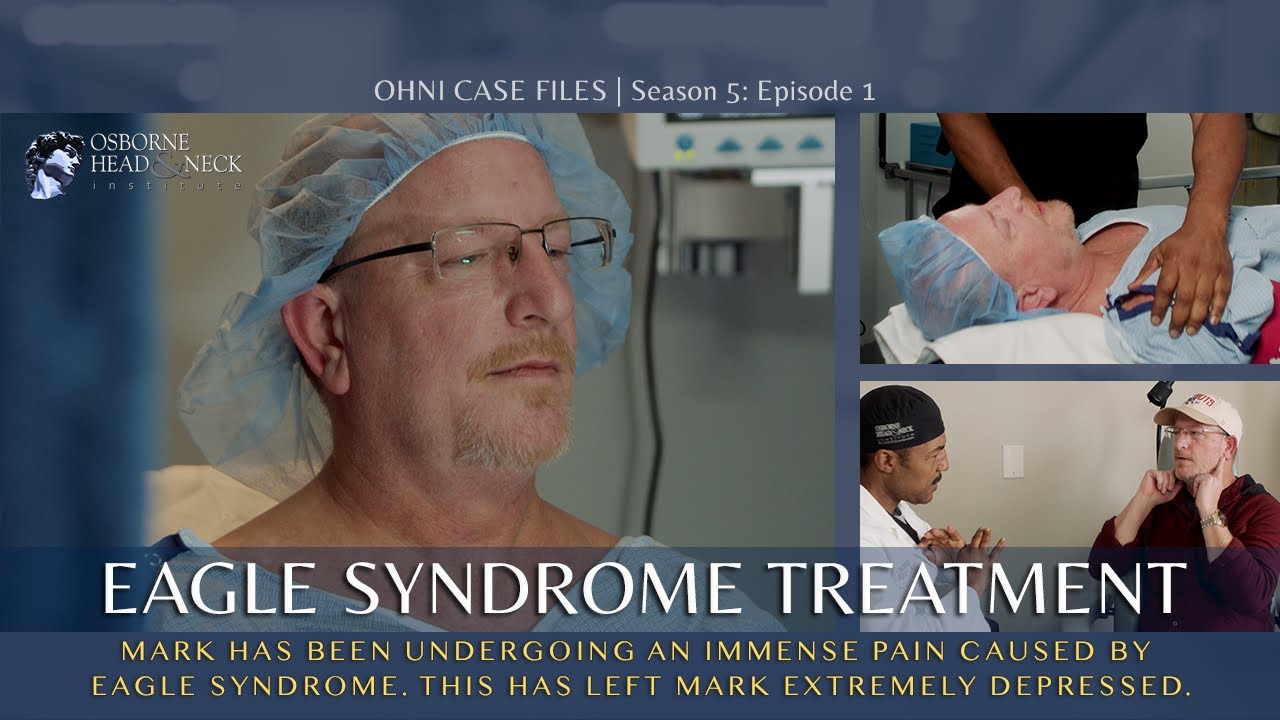
@Pamela1 - You may be interested in this video that Dr. Osborne posted. Only watch the first 5 minutes if you don’t want to see the surgeries:

The patient in the video was one of our members.

1 Like