Hey everyone im not sure if i have ES, TMJ or C1 issues, i do have CT scans with contrast that ive done, my question is one doctor has told me its TMJ another has told me Eagle Syndrome another has said it is a misalgined c1 and c2, i have some symtoms of ES but i dont have any throat pain or pain when moving my neck common tell tales of ES, and when i initally went in and the ENT mentioned eagle syndrome he was very quick to diagnose that within 10 min of looking at me (kind of seemed “happy” was telling people around the office) but my main symtoms are pain infront of my ear where my jaw and ear meet, base of skull/upper neck pain with sometimes shooting pains up my skull, headaches, ear pressure/ head pressure, chest tightness and ive noticed heart palp once all this started happening and sometimes feels like constant dizziness not like im going to faint but off balance, ive been told by another ENT i have fluid buildup in my middle ear a few times and tried taking alergy meds but none have worked, after a month or 2 of dealing with this seems like the almost all the symptoms went away (beside some dizziness that lingured and ear pressure) and i was happy but about 4 weeks ago every came back but alot worse, near constant headaches, dizziness ear pain and jaw pain, i do also have some clicking in my jaw also and alot of crackling in my upper neck.
When the ENT diag me with ES my ct scan showed Calcified Styloids left measuring 4cm and the right 3.6cm most of my symptoms happen on the left which is the longer side but with different doctors telling me different thing im not sure how to approach this.
Wanted to post some of my CT scans ive done to maybe get some insight as im going to a TMJ specalist today for a TMJ ct scan and xray and wants to bill me $4300 for a TMJ 24/hr splint.
@FM1999 welcome to the forum. There are many overlaps of jaw, ES, and cervical spine symptoms. And sometimes there are a combination of things going on. For example, both spine and ES could result in jaw tension and/or misalignment resulting in symptoms. It’s also theorized by some that ES forms due to jaw/teeth issues. So there’s lots to consider.
I am one of the main members who helps other members with their imaging. Typically, members will put their CT files into a folder on google drive and then send me a private message to the folder so I can download the imaging and take a thorough look at the entirety of the imaging (there’s a lot to look for). I can do this for you if you’d like? You’d no longer be anonymous to me, but I would not be sharing any of your personal information. Let me know what you think.
Update: Did my TMJ assessment they did a TMJ CT scan and xray and jaw range of motion test turns out I DO NOT have tmj based on all the test I have a very slight issues with my left TMJ joint, which he mentioned would not be causing my issues,I also let him know of my ES and he pressed around my neck and near my tonsils and I didn’t have any pain in the areas he was pressing on and mentioned he doubts it’s ES just due to not feeling pain in those areas and not having throat pain etc etc ( the office isn’t just a dental place they are a headache and neck institution also and he is also familiar with ES and has many patients with elongated/Calcified styloids) so leaves me with more questions than answers
@FM1999 - A sore throat is not a symptom everyone has w/ ES though many doctors believe it is THE symptom that needs to be necessary for an ES diagnosis. The angle of growth, how curved, thick, twisted or pointed a styloid is plays a lot into where & what kind of symptoms it is causing thus the external tests the TMJ specialist did wouldn’t necessarily disprove you have ES. Your styloids are both plenty long enough to be causing the symptoms you have. It seems to me he may not be fully informed about the very great number of symptoms ES can cause & the ways it can affect the body.
Additionally, some of your symptoms seem to possibly point to compression of your internal jugular vein.
When a doctor is familiar w/ ES it does not take long to diagnose it. The ENT I saw gave me a potential diagnosis of ES by my symptoms alone before I even had a CT scan, then he referred me for a CT which confirmed I had it bilaterally. My main symptom at that time was pain at the front of my neck & a lump under the left side of my jaw.
If you’ve sent your imaging to @TML, hopefully he will be able to help you further.
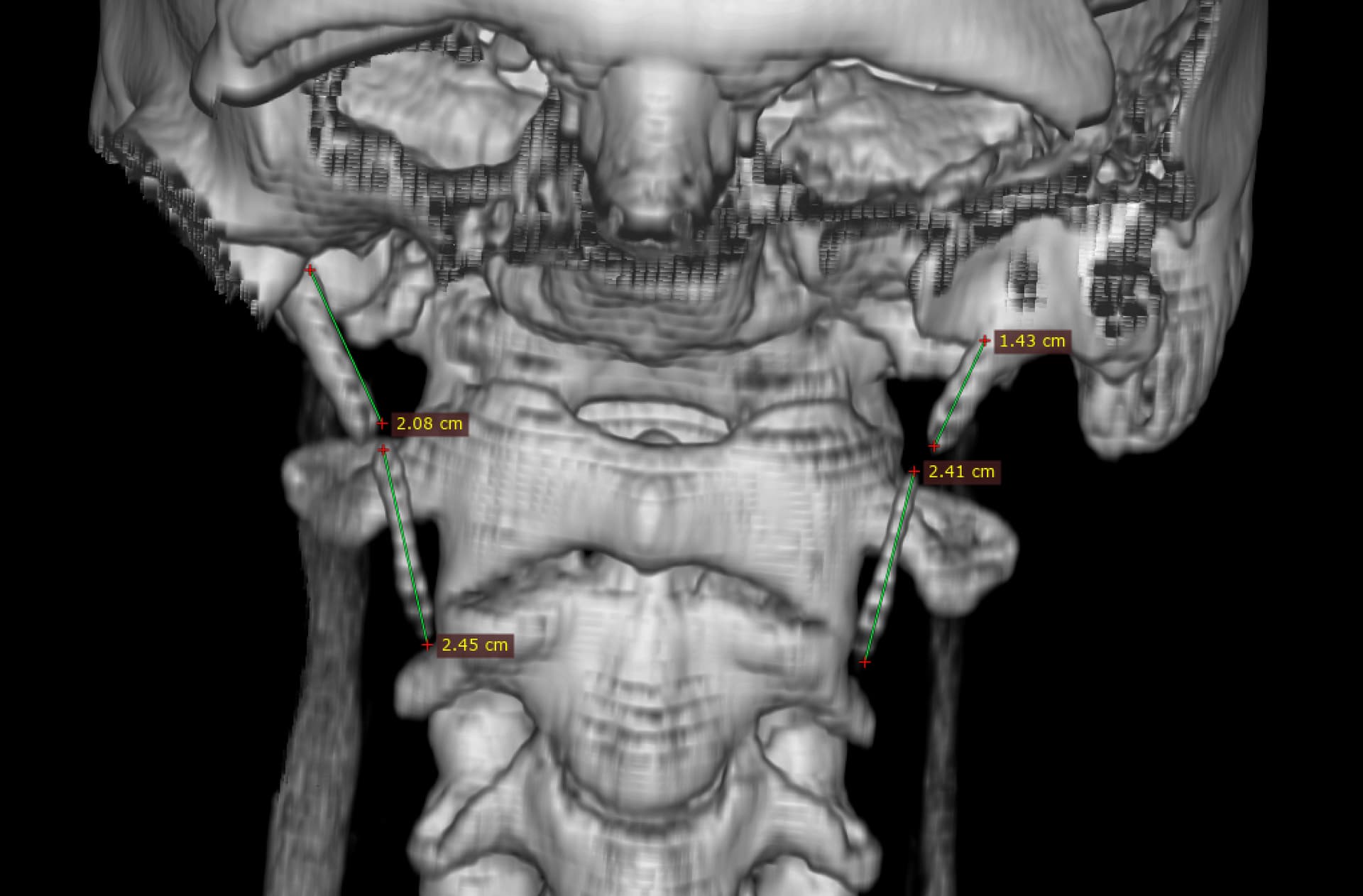
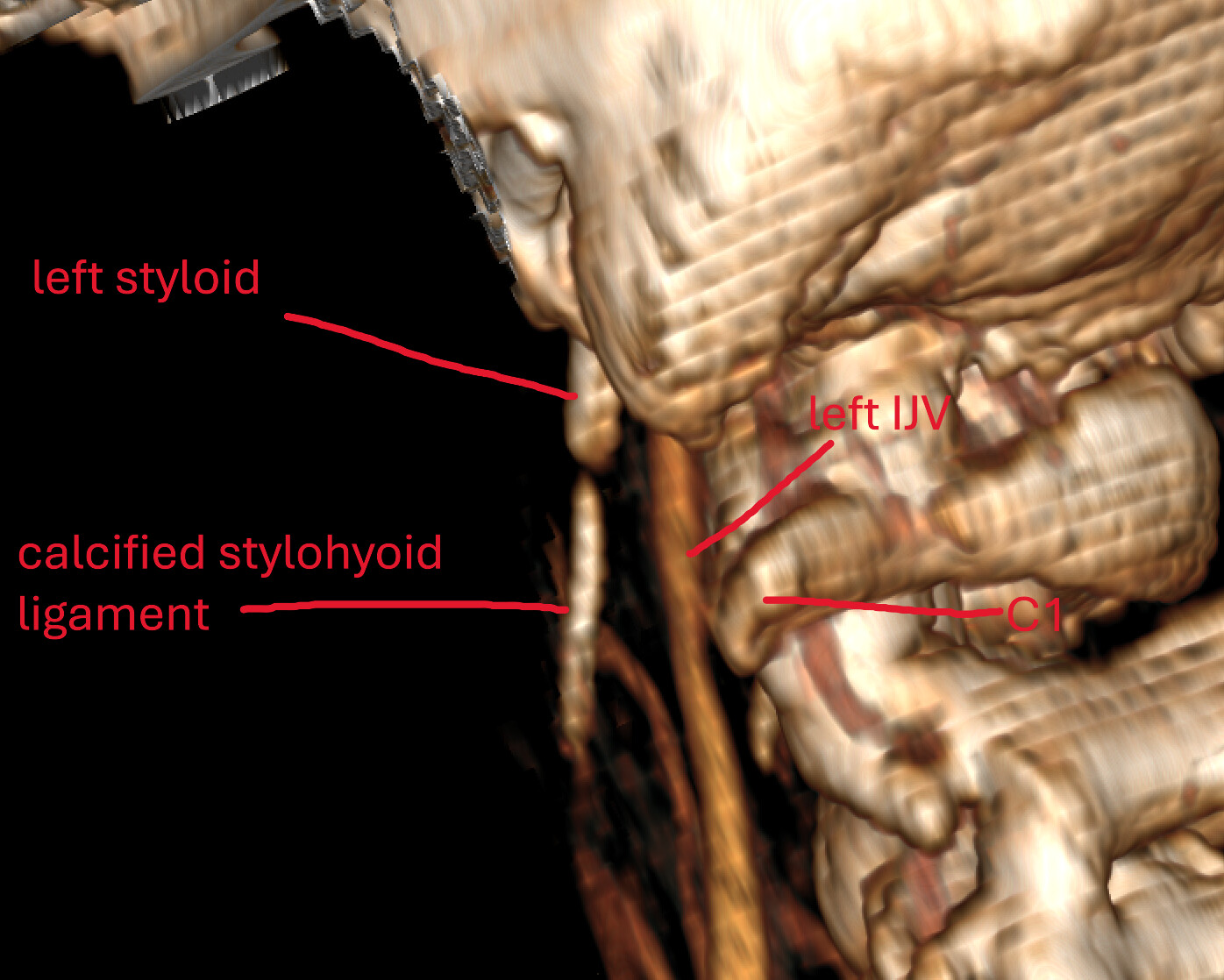
At the level of C1, both IJVs are compressed against the C1 transverse process. The styloids are quite a distance away and not contributing to the IJV compression. Sometimes when the IJVs are compressed against C1, so too are the vagus nerves that run between the IJVs and C1. Vagus nerve compression presents as heart rate and blood pressure dysregulation, sometimes vasovagal reactivity, and often times stomach issues (largely acid reflux).
The IJVs do not become compressed at any other location.
Further down, at the tips of your styloids (technically the tips of the calcified stylohyoid ligaments), both of the tips are in contact with your ECAs. Since these arteries supply blood to your ears, pressure changes due to compression are likely to cause ear symptoms - tinnitus, ear pressure, pain, etc.
I have attached 3D constructions of your styloids/stylohyoid ligament calcifications and provide rough measurement estimates.
Of course, we can’t see nerves in CT. However, I would suspect that any pain you are experiencing is either the stylohyoid ligaments irritating nearby nerves and/or irritation of the ECAs from the calcifications which are causing referring pain.
In a perfect anatomical world, your stylohyoid ligament calcifications would not be in contact with your ECAs and your IJVs would not be pressed against C1. If these are truly what are causing the issues, the fix would be C1 shaves bilaterally, and removal of the calcified stylohyoid ligaments. There could potentially be exercises for the C1 piece (which may actually be a whole cervical spine issue), but not sure.
Reminder that I am not a doctor nor radiologist. Hope this helps!
This helps a lot I appreciate it, as for as the styloids touching the ECA, very rarely do I get ear pressure and ear pain and 8/10 when I do get ear pressure It’s pretty bearable mainly in the sense of the the possible complications of surgery don’t out weigh the the discomfort in the ear (as of now can’t say in the future) and the C1 would adjustments and exercises help get that back in line cause most of my unbearable pain is neck pain and headaches.
@FM1999 that makes sense regarding the surgery risk-benefit analysis. However, I think the stylohyoid ligaments are the source of the pain (regardless of ear symptoms). So might want to think about thar piece.
I personally would avoid any manipulations (i.e., chiropractic treatments) of the upper cervical spine as such adjustments could actually loosen the vertebrae ligaments temporarily and worsen IJV compression. Sometimes such adjustments help, but other times they can cause a lot of problems symptom-wise.
There may be exercises that could help. I did also notice that your neck curve is losing it’s lordotic curve (at least in the 3D model) - in other words, it looks like your cervical spine is becoming straight (you are laying down during the imaging so it’s hard to say exactly how much curve you got during every day life). Theoretically however, this could be the best curve currently for you because if you gain lordosis it potentially results in middle vertebrae (e.g., C3-C5) pulling C1 forward with them. There could be exercises that pull C1 back though. Maybe exercises for muscles that are connected to C1 that provide a posterior pull of the vertebrae like the levator scapula. I’m not a physiotherapist though so don’t quote me on any of this.
So in the images I was laying down, I will try some exercises and see if I get any sort of relief as the pain isn’t constant I mainly work at a desk and start the get the headaches and pain after a few hours of working and in the afternoon
EDIT: Note I also get ALOT of neck popping noises throughout the day when turning my head
Exercises typically take a long time before seeing any results, so be patient. I sit most of the day too and I find a chair that has a head rest is helpful and also a standing desk. If I don’t have a head rest then I find myself leaning forward. I also have a sticky note on my computer screen to remind me about posture! I find that my postural problems start at the hips with an anterior pelvic tilt, which encourages my forward head posture. My lower back feels so much better when I tilt/tuck my pelvis under me.
So far today I’ve kept a very close eye on my poster and done some neck exercises and for the first hour or 2 this morning my upper back and neck felt like they were on fire lol same with my traps they felt so tight when I wasn’t hunched over and trying to extend my neck and relax my shoulders BUT I can so far say I haven’t gotten my usual 1pm headache and sharp pains I was getting every day, I will def try the neck support and also the standing desk
Hi & welcome!
We do see quite a few members here who have several issues going on, like TMJD, CCI etc. So this makes it quite complicated to see what’s causing what, & sometimes surgery can be the only way to tell, but obviously nobody wants to have a surgery unnecessarily either!
I didn’t have the choking sensation or throat pain either, not everyone does.
Feeling off balance is a very common symptom with IJV compression, along with head and ear pressure , head aches (especially in the morning when you get up). You could try sleeping with your head propped up a bit, that can help.
Shooting pains up your skull could be occipital neuralgia which can be caused by tight muscles, but can be ES, sometimes with IJV compression, other veins at the back of your head swell & try to take over, which can cause this pain, although on your scan I couldn’t see any collaterals veins, usually they’re quite obvious…
As the vagus nerve is next to the IJVs, it could be that compression of your vagus nerve is causing the chest tightness & palpitations, or from carotid artery irritation that @TML spotted, and as he said…
Muscles can compress the IJVs, so it could be along with the C1 processes it’s causing symptoms. The SCM muscle could be involved- you could have a feel to see if yours are very tight & look into exercises/ stretches for those if you want to avoid surgery? The digastric muscle also often compresses IJVs; some of the VES doctors do remove a portion of this if it’s involved.
If you do want to pursue another opinion on your ES symptoms you could look into seeing Dr Costantino in NY, Dr Cognetti in PA, Dr Hepworth in CO, or Dr Nakaji in AZ. They are quite busy & some are booking appointments for 6 months away, so perhaps it would be worth you getting on their lists in case symptoms worsen, or if the exercises don’t help?
Often pressing on the styloid area does cause pain, so it’s surprising that it didn’t when the doctor pushed there, but doesn’t necessarily rule out that they’re causing some symptoms- many doctor inject lidocaine into that area & use this as a diagnostic tool, but it doesn’t always stop pain so isn’t reliable!
Thank you Jules and YES you were SPOT on all today while trying to “Fix” my hunched over posture and forward head my SCMs have felt insanely tight to the point where it feels like those muscles want to bring my head back down (I didn’t even know that what’s the muscles were called I assumed it was my traps lol) like I said earlier so far today I’ve had a lot of burning sensations in my traps and neck and upper back but thankfully not my headache and shooting head pains I get around the afternoon every day but only time will tell
@FM1999 - Try bringing your computer screen up to eye level so you don’t look down at it when working on it. Do likewise w/ your cell phone screen as the constant looking down is what causes the forward head posture & elevated, forward rolled shoulders over time. This is also called Upper Cross Syndrome. There are YouTube exercises that can help with that situation.
Here’s a link to a great discussion to help you understand your neck/shoulder posture better & exercises to help bring them back into proper function:
I have a much smaller detached calcified styloid on the left, but my symptoms overlap with yours – tenderness in front of ear + some on temporalis muscle, tenderness along the zygomatic arch, dull pain between coronoid process and condyle of the TMJ (just under zygomatic arch), neck pain from C1 transverse process (just under the base of the skull) travelling in a line down to just under the shoulder blade, sometimes burning in my masseter area, oftentimes (neuropathic) itching at the back of my throat there and around the TMJ.
I too have gotten “your TMD is small” and can sometimes eat chewy food, and sometimes just speech is enough to inflame my TMJ area. With neck pain being constant and with sharp pain with some neck movements.
I’ve also been using AI to see if it can provide alternative answers to ask doctors about (I don’t rely on AI for final diagnosis, of course). It came up with consistent alternative being myofascial issues in specific muscles of my neck and myofascial issues with medial and lateral pterygoid muscles with a neuropathic component (nerves being pinched/compressed, resulting in neuropathic itch + pain, which causes muscle spasm, which makes it worse, and on and on…).
Just wanted to share this. In your case, it may be more clear. Mine is 1.5cm of calcified ligament section, but sometimes that detached section may be moving and rubbing against innervated tissue. Also, consider the proximity of those sections to the transverse process of C1 – my calcified segment may be small, but it is <2mm from the C1, which means it could be affecting many nerves there.
Hope my rambling gives you more questions for doctors. Please, if you get some definitive answers from them (and they help), let those of us who are still wondering know. Helps us to diagnose with doctors as well.